Tuesday, February 19, 2013

Sight Words (K.RFS.3c)

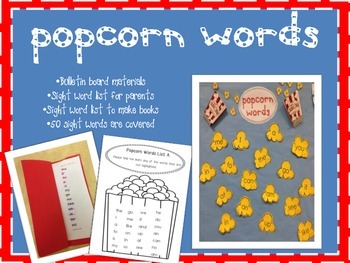
Update: I currently have a circus theme in my classroom, I have been calling sight words popcorn words and explaining how they pop up all the time in books that we read.  We highlight or "butter" popcorn words that we see on worksheets.  I made class visuals for a bulletin board, resources to send home, and resources to create the individual words for students to practice.  Click here to get your set. 

I also created a video to go with thse words


My kindergarten students know on average close to 100 sight words.  My district uses the Teacher College lists of sight words.  I cut a list of words in half and staple them into a book.  Every time a student learns and gets all 25 words highlighted in their book they move up to the next colored book.  We have a student in class that is on the black book (the last book of sight words) they think that is so cool.  This is very motivational for my kids and they can see their growth.  They love when they move on to the next colored book.  I also send a note home so parents are aware of the new words their child is currently working on.


I put this hangman game into a sleeve and the kids flip to a page in their sight word book and play hangman sightword to review words too.  The creater of this sight word sheet is listed at the bottom of the picture.


Check out this song to help kids learn Teacher College List A of Sight Words


Monday, February 11, 2013

Vowel Patterns (K.RFS.3b)


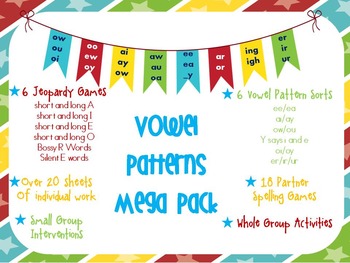
Update: I have created a vowel pattern mega packet to help teach these to kindergarten through 2nd graders.  The packet includes posters, jeopardy games, sorts, partner work of spelling words, small group interventions, and whole class activities.  Please click here to find out more!


I can not say enough about introducing Kindergartners to vowel patterns.  Every book out there has words in it that contain vowel patterns.  We do this video every day in my classroom to learn the sounds each pattern makes.  I have seen a huge difference in my kids reading abilities just from using this short video.  I had my daughters do the motions, this helps kids learn them quicker :)


We also work on spelling vowel patterns by using this chart.  I put the paper in a plastic sleeve to save paper.  We practice spelling words on it once a week.  If we come to one that has two different patterns I will tell them to circle the pattern that we are going to use to spell that word.


None of my kids came in reading.  I have 2 on level G, 4 F's, 1 E, 7 D's, 4 C's and 2 B's


Thursday, February 7, 2013

Bossy R Jeopardy


My kids had so much fun coming up with the clues for bossy r words.  I gave them each a half sheet of paper that had a bossy r word written on the top.  They had to come up with a clue for the word.  Then I typed them up into a jeopardy game.  We practice bossy r words a lot, they can make it very tricky to sound out a word if you don't know the sound they make. 
Each student has a dry erase board, we play boys vs girls. When it is your turn you get to pick the category and points amount. Every child writes the answer on their board every time. I have them all sit on the floor close to me so I can watch their spelling of each word. They love jeopardy and think it is so cool that they made the clues.  The game is just $1.00 on teacherspayteachers.com


                               http://www.teacherspayteachers.com/Product/Bossy-R-Jeopardy


Tuesday, February 5, 2013

Using pointers to track print (K.RFS.1a)


Common Core Reading: Foundation Skills
K.RFS.1


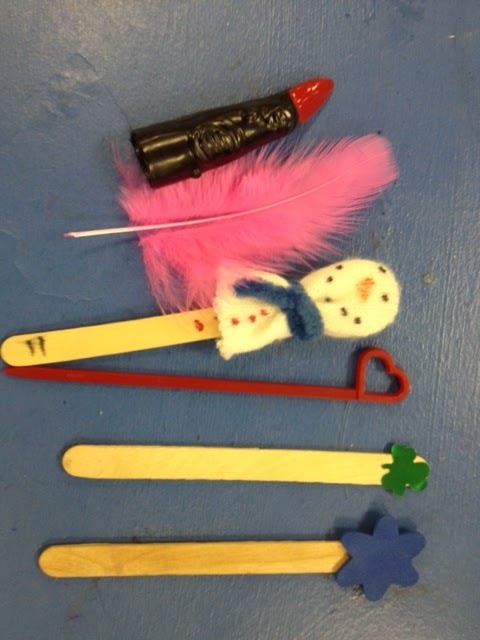
I like to provide my students with pointers to use when reading the books in their book boxes.  This provides them a fun way to practice tracking print from top/bottom, left/right.  I have them just use a plain stick for the first month of school.  I tell them if they are responsible and take care of their stick they will get "cooler" pointers as the year goes on.

August/September: popsicle stick with a smile drawn on
October: witchy fingers Oriental Trading
November: feathers
December/January: snowmen (cut the fingers off of white gloves, add a little cotton stuffing, a pipe cleaner scarf, and decorate with a sharpie.
February: Southwest Airlines stir sticks
March: Shamrock sticker, some years I make gold glitter sticks
April/May: foam flower


Friday, January 25, 2013

Happy 100th Day


We had so much fun on our 100th day of school today.  For our question of the day I asked the kids if anyone knew someone that was 100 years old.  I showed them a picture of what someone looked like that was 100.  Then we had our first challenge, could we come up with 100 words that we can read/write. We have been working on short vowel word families for quite some time.  They were each given a sheet and had to make a real word for each chunk or word family.


 After everyone completed their sheet I had the kids call out words they made for each chunk.  I wrote all the words on the board and they were excited to learn that we came up with 110 words!


Then we switched classrooms for different 100 day themed activities.  In my classroom we seen how many numbers they could write in 100 seconds, how many  letters they could write, and how many times they could write their name in one hundred seconds.  Each classroom competed and then I crowned one winner of each category for all of kindergarten.  After that we partnered up and played the roll to100 game.


In one of the other rooms the kids made glasses in the shape of 100 and painted 100 spots on a dalmatian   Each student had to bring in a 100 of something arranged in a creative way.  We put them all on display and went around to the other classrooms to see their masterpieces.  Here are a few of my favorites.


To round out the day we made hats that read I am 100 days smarter.  We had ten strips hanging off of our hats and made a picture of ten items on each strip.


Tuesday, November 27, 2012

Winter Bulletin Board Ideas


I wanted to do a winter bulletin board to hang out in the hall for a while.  I used a circle punch to cut out lots of white circles.  Then I assigned each student three sight words to write out on the snowmen.  We are going to go out in the hall and count how many sight words we can read/write.


For math we are working on addition so I used a die cut of a Christmas tree and the kids balled up tissue paper for the ornaments.


This was my November bulletin board.  We have been working on short vowel word families, each child was assigned a word family and on each feather they had to write a word from that particular word family.  On the turkey's clothes the word family chunk was written.  We went out in the hall and count how many words we could read and write as a class!


Sunday, October 28, 2012

Letter Sounds Book (K.RFS.3a, K.RFS.1d)


  • CCSS.ELA-Literacy.RF.K.1d Recognize and name all upper- and lowercase letters of the alphabet.
  • CCSS.ELA-Literacy.RF.K.3a Demonstrate basic knowledge of letter-sound correspondences by producing the primary or most frequent sound for each consonant

    I am having great success with using a new approach to phonics and phonemic awareness.  When my kids come in at the beginning of the year their letter and sound knowledge is always all over the map.  I like for all my students to have mastered letter and sound recognition by Halloween.  This allows them to build from a foundation and move on to short vowel word families, manipulating phonemes, blends, and vowel patterns early in the year and get lots of practice at these higher level skills.

    Starting with the first day of school every student is given an ABC book that we practice first thing each morning.  The book follows the same format as going through an alphabet chart.  Students repeat the letter, sound it makes, and picture.  However, I find it way more successful for a few reasons.

    * It isolates only 5 letters on a page at a time. (After they repeat after me for the 5 letters, I give them a word that would start with one of the 5 letters and they have to pick which letter is making that beginning sound.  This gives them beginning sound isolation right from the start.

    * They each have their own copy of the book, every student points to the letter we are on.  The visual being in their own hands and them verbally saying each letter helps to make it more concrete for them.

    * When I ask the question about a word and what letter it would start with, they all write the letter on their whiteboard.  This gives them practice writing the letter and gets everyone involved.


    This whole activity only takes 5-7 minutes, I chose to put the vowels at the end of the books and all of the consonants first.  Before we practice the vowels I have the kids say: "These are the vowels, every word has one: a, e, i, o, u, and sometimes y.