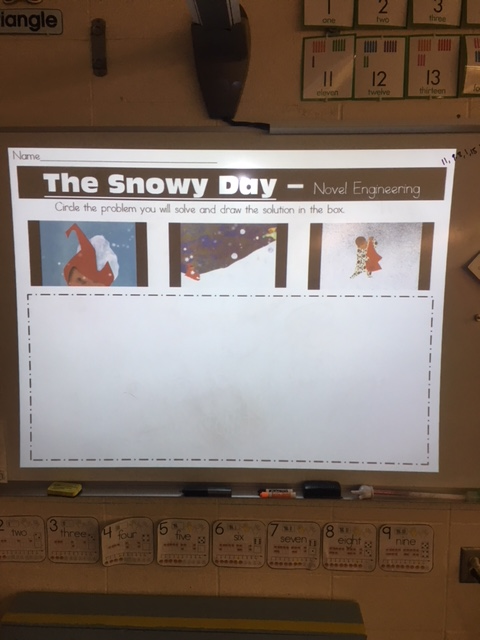
For this lesson I posted some of the main problems Peter had on the board after we read the story. They picked if they wanted to work in a small group or individually. Then they were given a planning sheet. I had bags of materials gathered ahead of time for them to use since this was our first experience. They shared their ideas at the end. What a fun experience!
Friday, April 13, 2018
Novel Engineering Snowy Day
I have been going to STEM training through my school district this year. I have tried to start incorporating what I am learning in the meetings into my kindergarten classroom. This post is one of three novel engineering experiences I have tried this year. I read the book The Snowy Day in January and asked them to come up with an idea of how to help Peter.
Friday, March 2, 2018
Acting Out The Enormous Turnip
Friday, August 7, 2015
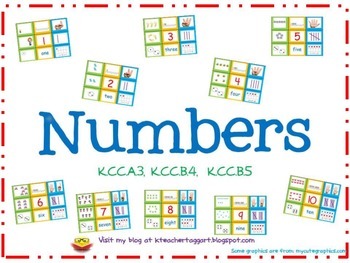
Numbers 1-10
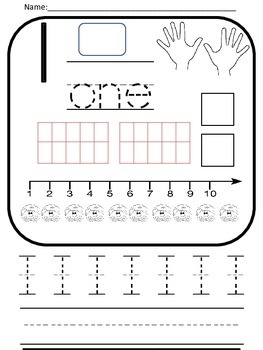
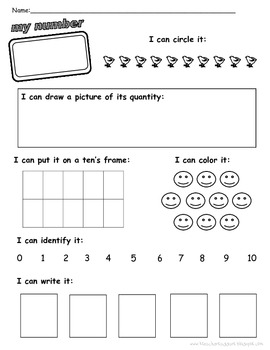
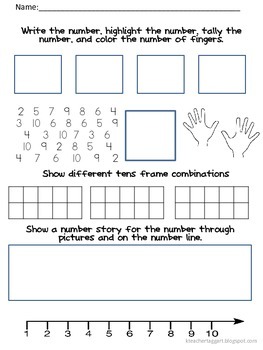
It always amazes me how little concrete knowledge most of my kiddos have about number sense. They might have the number three memorized because of the way it looks but they have no idea what three means. I like to show my kids lots of examples of how a number can be represented. You never know what might click for some students and what works for others, so I like to use many examples. I created this song to help kids have a better sense of what each number represents. I have also made posters that hang in my classroom and I refer back to as the year goes on. In addition I have other sheets I like to use for kids to see numbers in many ways. Check out the song and resources below to help get your kids to have a clear meaning of the numbers 1-10.
Video
Number Posters
Number Practice
Rule Breaker Sight Words
My students are pretty good at learning basic sight words but those tricky one that break all the rules can cause them problems! I made this song to help them remember some of the ones they can not sound out and just have to memorize. I encourage them to yell out the word when they recognize it while the song is playing. I also made this packet of worksheets so they can get extra practice with each word.
Packet
Video
Packet
Wednesday, February 18, 2015
Math Strategies
I have been teaching my kinders math strategies and tools they can use to help them add and subtract. I explained how just like we have reading strategies to helper readers, math strategies can help mathematicians. I spend a week practicing using each strategy, make sure they know using tally marks only works well for addition problems. Then I like to mix up problems and have practice adding and subtracting at the same time. I made a song to help them remember the strategies, made posters to hang on my math board in the classroom, and created practice sheets to work on each strategy. I also have them play partner games and participate in whole group activities during the weeks I spend on this unit. My practice sheets and posters can be purchased by clicking on the link below. I have 16 different sheets and 5 posters included in the set. The link to the youtube song is also found below!
Tuesday, September 23, 2014
Three Bears Acting Out
My students love to act out the story Goldilocks and the Three Bears. It is so funny to hear them change their voice for each character. From time to time I like to give them little props they can take home to retell stories to their families. I run all of the materials for this on different colors of construction paper and quickly cut them out. They glue the pieces in order and move the bears and Goldilocks around to tell the story. They keep Goldilocks and the bears in a library pocket I stick to the back.
If you would like to purchase it for $1.00 click on the link below
Behavior Plan
I have tried a new positive behavior plan for my classroom this year and it has made a world of difference. I have found that focusing more on the positive things that kids do right is much more beneficial than correcting the negative things. Every child likes attention and this system has made it easy for me to complement good behavior. I have a circus theme in my classroom so I went with a balloon for each child. I fill their balloon with a bingo dabber stamp each time I noticed them doing something good. This might be as simple as the first child who comes to the carpet and sits correctly or someone who uses good manners. Every child has a number in class and the balloons are displayed in the classroom. When a child balloon is full of stamps they are awarded a prize. They can pick from one of eight things including being the line leader for the day, using the super supply bucket for their work, being the class DJ, or picking out of the treasure box to name a few. When their balloon is full it is taken off the bulletin board and they take home a certificate celebrating their accomplishment. Then I replace their balloon with a new one and they start over again. The materials for the bulletin board, award certificate, and prize cards can be found here.
Reading Comprehension
I added on to my circus/carnival theme this year and created a train for my reading comprehension strategies. I feel like I always start off the year covering and introducing the first few great and as the year goes on I get busy with other things and I fall short. I took these straight form the Kindergarten Common Core Literature Standards. I hung the train in front of my meeting area and have been referring to a lot already. This narrowed things down for me and seems more Kindergarten appropriate. Above the train it says Good Readers Always Stay on Track, you can purchase the posters and make your own train by clicking here.
http://www.teacherspayteachers.com/Product/Reading-Comprehension-Train-for-Kindergarten-CCSS-1391630
RL.K.1 , RL.K.2, RL.K.3, RL.K.4,
http://www.teacherspayteachers.com/Product/Reading-Comprehension-Train-for-Kindergarten-CCSS-1391630
RL.K.1 , RL.K.2, RL.K.3, RL.K.4,
Tuesday, March 11, 2014
Good Night Owl Acting Out
Wednesday, March 5, 2014
March Display
3 D Shapes CC.K.G.1
To introduce my students to 3-D shapes I like to use the you tube song These are the 3 D Shapes That I Know. This gives examples of shapes in their environment and begins to teach them the vocabulary words for these shapes. Then we work as a class to complete the sheet. I play a video for the specific shape we are on and we look at the pictures of things shaped like that. Then I call on three different students to pick an object we should draw on our own paper. This activity usuall takes two 25 minute sessions to complete. If you click on the document you will get a print out of the two sheets I use, one for each day. This is the video for the cube, once you play it you will see the links for all the other shapes.
During the week we also sort pictures of 2 and 3-D shapes, make shapes out of clay and popsicle sticks, and play a guessing bag game of 2 and 3-D shapes. I would love to hear how you teach shapes in your classroom.
Tuesday, March 4, 2014
Caps For Sale Acting Out
There have been several stories this year that we have enjoyed acting out as a class after reading a few times. In the story Caps For Sale we had one student take on the role of the peddler and the rest of the kids were the monkeys. I used a large plastic container that had pretzel rods in it at one time for the peddler's hat and a paper plate for the face. The rest of the students cut out the monkey face and we taped a big Popsicle stick to the back. They were assigned a color cap and glued it to their monkey mask. Each child also had a cut out hat piece that they threw down. This was very easy to create and students really enjoyed it!
Click on the picture of the monkeys to find the printable template for the monkey mask. I would love to hear about the stories your kids enjoy acting out!
Wednesday, January 22, 2014
Duck Pond Phonics Game
I have a carnival theme in my classroom this year. I purchased plastic ducks from Oriental Trading and taped a vowel pattern to the bottom of each duck. You could use this game to practice word families too. One student comes up front to select a duck and the class says the following rhyme...
__________ went out one day, picked up a duck and what did it say?
(child's name)
I just placed all of my ducks on a blue lid to a container. The student holding the duck reads the chunk on the bottom of the duck and we write the word in the pond. Each student has a copy of the sheet, I put the sheet inside a plastic sleeve. We use our dry erase markers and erase after each vowel pattern. I tell them the words we will practice spelling for the vowel pattern that is chosen. Here is a n example of the spelling pattern ay.

Here is a copy of the sheet I use. I would love to hear any other ideas on how to use this game to practice different skills.
Friday, January 17, 2014
CVCC Words
We have moved on to learning harder word family chunks. My class is now working on cvcc words. We are learning the chunks ack, ick, ock, uck, all, ell, ill, ish, ash, ast, ust, est, unk, ump, and, ush, ook and a few others. I have made a packet of the daily instruction I use to teach these chunks and a few games that they play each week to practice reading and writing the chunk. I try to incorporate words that begin with blends so we can continue to review previous skills. I have a few kids that are still having trouble with rhyming words so I also tie in that skill. I teach the kids that we want our brains to know that when these letters get together they make a sound and the sooner we learn these tricks the better readers we will become.
The games and activities in this packet meetthe following common core standards
K.RFS.2.c. (blend and segment onsets and rimes)
K.RFS2.d (isolate and pronounce initial, medial, and final sound of cvc words)K.RFS.3.a. (produce primary sound for each consonant)K.L.2.c (write a letter for most consonant and short vowel sounds)
K.L.1.a. (print many upper and lowercase letters)K.L.1.f. (produce complete sentences)K.L.4.a. (discuss multiple meanings of words)
These activities would also work well in a first grade classroomand meet common core standards 1.RFS2b, 1.RFS2c, 1.RFS2d, 1.L.1a, 1.L.2d
In the packet I have included posters that I hang up in the classroom. I notice students looking up at the posters during reading and writing time quite often. I believe the more they visually see it the faster they will retain it. This is a picture of some of the posters included in the packet.
This is one of the games included, there are three different ways to play. Each way gives students practice reading and spelling words.This is my cvcc folder. I use this format all throughout the school year and change out the phonics skill each time. It is a quick easy way to practice skills and has been highly effective with my students. I start with the alphabet folder and progress to cvc words, blends, cvcc words, and long vowel patterns. This packet includes the directions and pages needed to create the cvcc folder.
Wednesday, December 11, 2013
Christmas Coutdown
I had my kids create a Christmas Countdown. We used a Santa coloring sheet for the top and then made a long beard to write numbers on. Every day they cut a number off of his beard. We are working on recognizing and writing teen numbers. This gave them a little extra practice in a fun way.
Coaching a Reading Partner
I love this time of year, all my students are finally reading! Everything that we have been working on really starts to click and their progress begins to soar. Since they have grown to have some independence it is the perfect time to start my mini lessons on coaching a buddy. Every day for 20 minutes I have my students practice reading with a partner that they are assigned to. The sooner I can teach my students that they can be a teacher to the person they are reading with the faster they climb in reading levels. I explain it to the kids that I am only one person and even though I would love to read with each and every one of them every day there is just not enough time. However, they are very lucky because they have a friend that sits right next to them when they read and they can be the teacher and help coach them! We talk a lot about how two brains are better than one. I made a song to help them remember what a good coach does.
We made stop signs to hold up when something our partner reads doesn't make sense or sound right. On the back of the stop sign is four things for a good coach to remember. These are sung about in the link above. I have my kids make motions to go with the song. I have also posted posters of the four tips for coaches in my classroom. In addition, I have created a coaches club. After I catch a student being a good coach to a buddy on five separate occasions they get to sign the board. These small changes have really helped a lot to get my students to pay attention while their partner is reading. I think kids learn the most when they are actually involved and part of the teaching process. They have really been having a lot of fun being the teacher!
Tuesday, November 26, 2013
Thankful Turkeys
Here is a cute and easy turkey for kids to make. If you click on the picture a template for the feathers and body are provided. I let the kids make the feet and beak themselves using orange construction paper. I think those little touches help make each one unique and cute. I read the book Thanksgiving is for Giving Thanks before making the turkeys. Then we come up with something we are thankful for to write on each feather. I have the students write in pencil and then after I have checked over their work they can trace in black marker. Happy Thanksgiving!
Wednesday, November 13, 2013
Beginning Blends
My students are all doing really well spelling cvc words and we are moving on to practicing blends. We will still be working on stretching out words and recording the sounds. I have a morning activity that we will do each morning to practice this skill using blends now instead of cvc words. Blends are not listed as a kindergarten common core skill however, the books that students are reading in kindergarten contain words with blends. Since my kids know all of their letters and sounds now, this is the next logical step as far as phonics instruction. I think of blends as a shortcut for sounding out a word. We also start to work on digraphs during this time. I have created a video that has all of the blends we work on. Students make up a motion to go with each blend. This has proven to be helpful for some students who are kinestic learners to remember the sound.
I have created a blends folder that we will work on each morning. Blends are reviewed during this time and the movement and sound is practiced. Students also write words that contain a blend in the beginning of the word. All of this is done with students having their own folder with visuals to point to each blend and a space to write the word. I have included the link to the activity, this packet also includes posters to hang as visuals in the classroom and several games partners can do to practice blend sounds.
Turkey Time
Tuesday, November 12, 2013
Partner Reading
Update: I have created a resources and visual display for kids to help them remember what a good reading coach does. These things go right along with the video found below! Click on the picture for the resources. Happy Coaching!
Children learn so much from each other and gain new understandings by talking to partners. Each day in my classroom I have students read with an assigned partner that is on the same level as them. Students work on the three ways to read a book during this time. I start my partner reading time with a mini lesson and then tell them the type of reading they will be practicing for that day. As the year goes on and students progress into reading the words of books I phase out the read to pictures type. There are four ways to read with a partner. In the beginning of the year I tell groups which way to practice and as the year goes on students are able to pick.
1. I read a page, you read a page (students take turns back and forth reading the pages)
2. Echo reading (one student reads a page and the other student repeats)
3. Choral reading (both students read the words at the same time)
4. I read a book, you read a book (one student reads an entire book, and the partner reads a whole book)
Here is a link to posters I have in my classroom for students to remember the types of Buddy Reading
I have them practice sitting criss-cross and both holding on to the book. This way both partners can see the book and whoever is not reading can follow along and help coach their buddy.
Coaching Video
Children learn so much from each other and gain new understandings by talking to partners. Each day in my classroom I have students read with an assigned partner that is on the same level as them. Students work on the three ways to read a book during this time. I start my partner reading time with a mini lesson and then tell them the type of reading they will be practicing for that day. As the year goes on and students progress into reading the words of books I phase out the read to pictures type. There are four ways to read with a partner. In the beginning of the year I tell groups which way to practice and as the year goes on students are able to pick.
1. I read a page, you read a page (students take turns back and forth reading the pages)
2. Echo reading (one student reads a page and the other student repeats)
3. Choral reading (both students read the words at the same time)
4. I read a book, you read a book (one student reads an entire book, and the partner reads a whole book)
Here is a link to posters I have in my classroom for students to remember the types of Buddy Reading
I have them practice sitting criss-cross and both holding on to the book. This way both partners can see the book and whoever is not reading can follow along and help coach their buddy.
Coaching Video
Subscribe to:
Posts (Atom)